„The future depends on what we do today.“
– Mahatma Gandhi –
They say you should celebrate occasions as they come. Monday marked the 70th anniversary of Paul M. Müller’s founding. For us, this is a reason to take a moment to reflect, raise a toast together, and look back on seven decades full of changes, bold decisions, dedicated people, and challenging times.
The story of Paul M. Müller began in 1956 with the company’s founding in Straßlach. However, the first few years following the takeover by Dr. Schurz and Mr. Hoffmann did not take place in modern office buildings or large logistics centers, but rather in a Munich apartment. The accounting department was set up in the bedroom, the typing pool in the children’s room, the CEO’s office in the living room—and the printer found its place on the bathtub. What sounds almost nostalgic today shows that entrepreneurial success rarely begins with ideal conditions, but rather with people who take responsibility and have the courage to get started.
Back then, no one could have imagined where the journey would eventually lead. But what was needed right from the start was courage. That same courage was needed later on, as the company gradually evolved from an importer specializing in the Far East into a more broadly diversified food company. My father built up the European business, thereby laying an important foundation for the growth that we continue to this day. The move from Munich to Oberhaching in 1991 was also a decision that required foresight and confidence.
In hindsight, such steps often seem obvious. At the time, they were not. Perhaps that is precisely the most important lesson from 70 years of our company’s history: Every generation faces its own challenges. What matters is not whether changes will come, but how we respond to them. Today, we live in a time of great uncertainty. Geopolitical tensions, volatile commodity markets, rising sustainability demands, and a weak economy are issues our industry faces every day. At the same time, customers rightly expect quality, reliability, and competitive prices.
But anyone who can look back on 70 years of company history also knows that good years and difficult years are all part of the journey. So are challenges. What’s important is to remain open to growth. That’s exactly why we want to consciously focus on the future in the coming weeks. Under the title „Optimism for the Future,“ we’ll be featuring people from our industry in Food News and on our social media channels—people who recognize opportunities, take on responsibility, and get things done. And, of course, this issue will once again bring you updates on developments in the international commodity markets and topics currently shaping the industry.
With that in mind, I hope you find our latest Food News inspiring—and may you always have plenty of optimism for the future.
Sincerely,
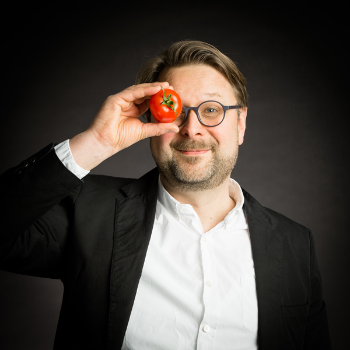
Yours sincerely, Thomas Schneidawind
In Greece, the apricot harvest has begun, while the peach harvest is just around the corner. This allows for initial estimates of harvest volumes and price trends.
Our partner expects a good harvest for both types of fruit. For peaches, the current estimate is around 400,000 metric tons, which would represent an increase of over 30 percent compared to 2025. Despite the higher availability, prices for the raw produce remain high. Lower prices would jeopardize the economic viability of peach farming and could lead producers to switch to alternative crops such as cotton or tobacco. In addition, the comparatively high proportion of smaller fruits makes the production of canned fruit more difficult, and there are virtually no available stocks from the previous season. Against this backdrop, our partner in the canned peach sector currently expects price increases averaging 5 to 7 percent. However, larger deviations are possible, as pricing already varied significantly among manufacturers last year. More concrete information is expected in early July once packing begins.
For apricots, production began on June 12 with a trial run. Regular processing has been underway since June 15. Stable raw material prices are now available depending on the region and are at last year’s levels: In the Peloponnese, where the raw material is of the highest quality, the price is 0.45 euros per kilogram. In Larissa, the raw material price is 0.42 euros per kilogram. According to our expert’s assessment, prices are expected to rise as the season progresses. A major reason for this is high demand from the frozen food industry.
Several factors are currently driving up prices for both apricots and peaches from Greece. These include higher energy costs resulting from the conflict between Iran and Israel, as well as higher labor costs. The latter are necessary to attract enough workers to work in production facilities under high temperatures.
In China, the apricot harvest has been complete since the end of May. The harvest volume is about 30 percent below last year’s level. At the same time, raw material prices have risen by about 30 percent compared to 2025. It is currently not possible to reliably estimate how prices for canned goods will develop. This is due to high demand from the frozen food industry, which is competing with canners for the available raw materials. Local experts therefore estimate that canned apricot production will be only about half of last year’s volume.
Pineapple season in Thailand is in full swing—but the summer harvest is small. Prices climbed in May from 6.20–6.35 THB to 7.50–8.20 THB per kilogram of raw fruit. Supply remained tight in June as well, causing prices to rise to 8.30–9.20 THB per kilogram of raw fruit (as of June 11, 2026). In addition, due to the dry weather, most of the fruit is small. This is particularly limiting the production of sliced pineapple. Since the third week of June, many processors have reduced production to three to four days per week. Packers expect production to end in mid- to late July.
The outlook for the winter harvest also remains uncertain. The Thai Food Processors Association (TFPA) anticipates a delayed start to the season in late October and a significantly reduced supply. This is due to the ongoing effects of the El Niño weather phenomenon. With an expected harvest of 70,000 metric tons per month between October and December, the total for 2026 would be less than one million metric tons. As a result, prices could once again reach the levels seen in 2024 by the end of the year, when up to 12 THB was paid for one kilogram of pineapple.


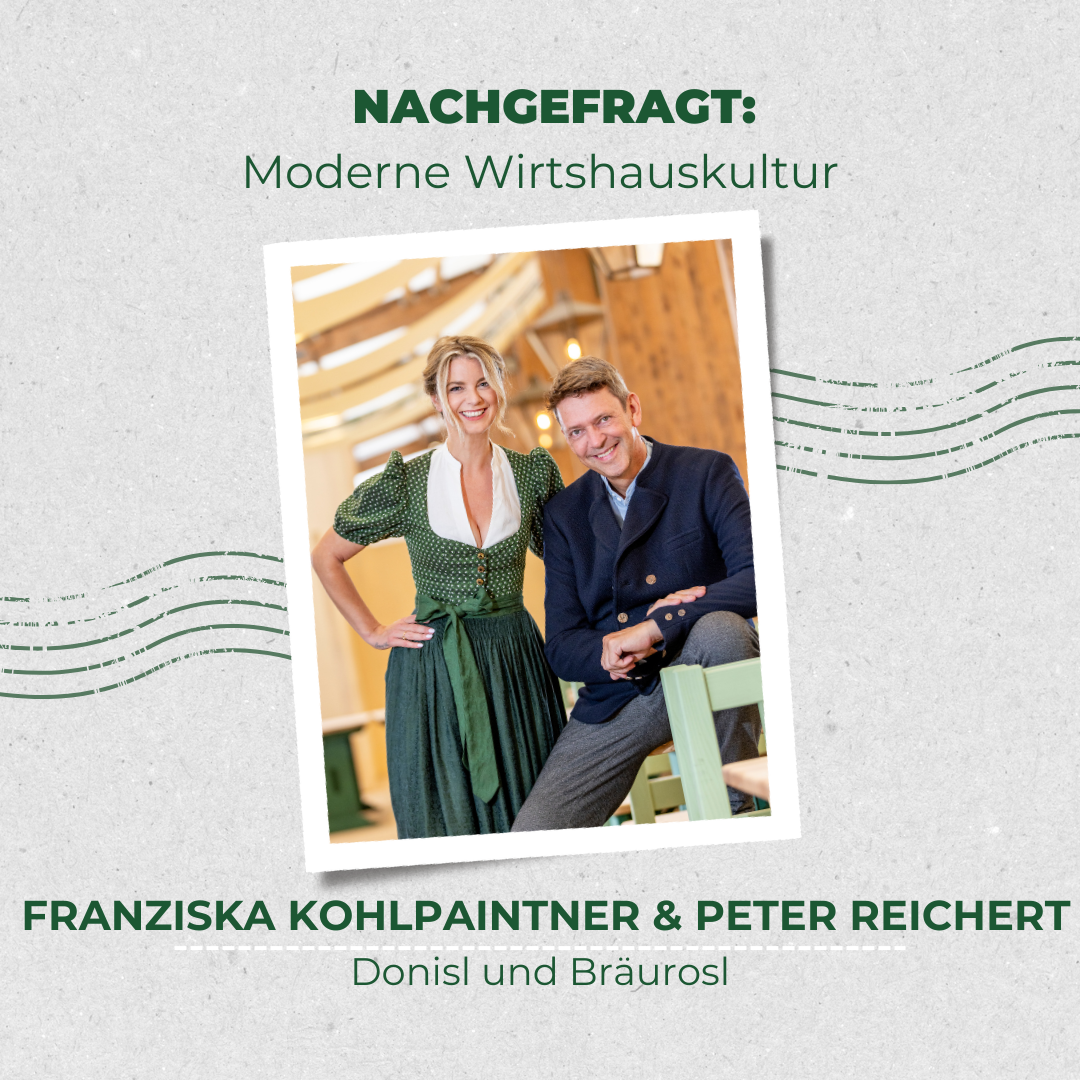
What makes a good tavern in your opinion?
Peter Reichert: Down-to-earth charm, regional character, and friendly service. And a certain beer culture. After all, there’s also a culture of glassware and table settings—and for me, that includes the way beer is poured and presented. It’s not just about the product itself, but also about the atmosphere and appreciation. That’s why, at Donisl, for example, we place great importance on draft beer from wooden barrels.
Franziska Kohlpaintner: A good tavern also needs a relaxed atmosphere. Guests should walk in and immediately feel welcome. Above all, though, a tavern needs a soul. That comes from the people—the owners and the staff—but also from the space itself. At Donisl, many personal items, collectible mugs, and musical instruments hang on the walls. This creates an atmosphere that feels authentic and brings the history of the place to life.
Over the past few years, you’ve modernized the Donisl with events like „Tanz in Tracht“ and the „Kulinarium.“ Was this direction planned from the start?
Franziska Kohlpaintner: No, not at all. It developed step by step. Peter took over the Donisl in 2021—right in the middle of the COVID-19 pandemic. Back then, the main priority was to keep the business running, find employees, and establish a stable foundation.
Peter Reichert: At this stage, you don't immediately start thinking about large-scale event concepts. The first priority is just to get through it.
Franziska Kohlpaintner: Everything else has actually developed very organically together with our guests. Over time, you get a sense of which formats take hold and in which direction a place can evolve.
With „Kulinarium,“ you’ve made a conscious effort to attract new target audiences to Donisl. What’s the idea behind the concept?
Franziska Kohlpaintner: We wanted to show that traditional tavern cuisine and fine dining don’t have to be mutually exclusive. That’s why we invite top chefs to the Donisl to develop menus together with us. But it’s always important to us that the tavern’s DNA remains intact. Our philosophy is: upscale, but not pretentious. We don’t want „tweezers cuisine.“ It should always remain approachable and pay homage to traditional Bavarian pub cuisine. At the same time, this has also allowed us to attract guests who may not have been to the Donisl in many years. After an evening with us, some tell us, “I would never have walked in here otherwise.” And suddenly, they’re rediscovering the traditional tavern.
Peter Reichert: Basically, every culinary experience is a source of inspiration for us. Even if we see a French fry stand somewhere, we take a closer look: Why are people lining up? What kind of potatoes do they use? How does the concept work?
How do you define your target audience?
Franziska Kohlpaintner: That’s actually not an easy question to answer, because we cover a wide range of areas—from traditional à la carte dining to events, banquets, and our own event formats. Basically, though, Donisl caters to guests who are interested in Bavarian pub culture and want to experience it in a modern way.
Have expectations changed in recent years?
Peter Reichert: Absolutely. People are more intentional about going out these days. It’s no longer just about eating or drinking; it’s much more about the overall experience. Many people want to consciously take the time to enjoy an experience and have a place where they feel comfortable. In the past, it was often enough to simply be a good restaurant and open the doors. Today, you have to offer guests much more and constantly come up with new ideas.
Franziska Kohlpaintner: We’re realizing just how important real interactions have become. After all, restaurants are always social spaces. People of different generations come together, share stories, and want to leave their everyday lives behind for a few hours.
People are being more careful with their money these days. How can we still get guests excited about dining out?
Peter Reichert: People today think more carefully about what they spend their money on. By comparison, Bavarian restaurants aren’t really that expensive. Here, you can get a good meal made with regional products and excellent service for relatively little money. That’s a fair value for the price. And one of the advantages of a traditional tavern is that you don’t necessarily have to order a full meal. You can just as easily stop by for a beer or a light snack.
How have guests' dining and nightlife habits changed in recent years—especially during economically challenging times?
Franziska Kohlpaintner: Dining out continues to be very important to its patrons. Today, it’s much more about the overall experience. Many guests may be going out a little less often, but when they do, they want to consciously treat themselves to something special. Dining out isn’t just about food and drink—it’s also about socializing, that cozy pub atmosphere, and spending time together.
Donisl is located right in the heart of downtown Munich—but it’s somewhat tucked away in a passageway. Does this location present any particular challenges?
Peter Reichert: Locations in shopping arcades are generally considered rather challenging—whether in retail or the restaurant industry. From the outside, many people don't even realize what lies behind the Donisl.
Franziska Kohlpaintner: That’s exactly what we hear a lot. Many guests say afterward that they’re surprised by how spacious and atmospheric the interior of the restaurant feels. Still, our location right on Marienplatz is a huge privilege. In many ways, we certainly have it easier than an inn in the countryside.
How does delivery work in the heart of downtown?
Franziska Kohlpaintner: We can only receive deliveries between 6 a.m. and 10 a.m. That’s why our day starts very early. Practically everything comes in during that time—meat, fish, vegetables, and beverages. We work with many regional suppliers. Meat from the Werdenfels and Murnau regions, or fish from Lake Walchensee. For us, quality starts with our purchasing.
Regionality generally plays a major role for you. How important is this aspect to guests today?
Peter Reichert: When it comes to Bavarian cuisine in particular, sourcing ingredients plays an enormous role. Even the best chef can’t do much if the meat isn’t of the right quality. That’s why we’re very careful about which producers we work with.
The restaurant industry has been struggling with a shortage of skilled workers for years. How does this affect your day-to-day work?
Peter Reichert: Finding good employees has become significantly more difficult. But this applies to all industries—not just the restaurant industry.
Franziska Kohlpaintner: It’s more important than ever today to create a good work environment. When processes run smoothly and employees have the support they need, people actually enjoy working in the restaurant industry. A chef gets in a bad mood when equipment isn’t working or key ingredients are missing. A server gets in a bad mood when the cash register malfunctions or the beer is warm. Ultimately, it’s about ensuring that employees can focus on their actual job—being hosts.
Alongside Donisl, you also run the Bräurosl at the Munich Oktoberfest. How different are these two worlds?
Franziska Kohlpaintner: A day at the Wiesn is basically like a week—sometimes even a whole month—of regular operations. The pace is completely different, and a lot happens much faster. At Oktoberfest, you have to react within a very short time. If something breaks down there, you can’t just say, „The technician will come next week.“ You have to find a solution right away.
Peter Reichert: About 50 people work at Donisl, and around 500 at the Wiesn. There are about 240 employees working in service alone.
How long do the preparations for Oktoberfest take?
Franziska Kohlpaintner: Actually, planning begins even while the Wiesn is still underway. Many things are analyzed right away or discussed for the following year. And then the saying goes: After the Wiesn is before the Wiesn. First comes the complete takedown and the follow-up work. Things only really quiet down briefly in December—and after that, the planning starts all over again.
The Oktoberfest has also undergone culinary changes. What role do vegetarian dishes play today?
Franziska Kohlpaintner: It’s much more diverse than it was a few years ago. Originally, the Oktoberfest served only fried chicken, but that has changed over the years. Even though the “Wiesnhendl” is still the most popular Oktoberfest dish, guests now expect much more variety, including vegetarian and vegan options. There are incredible changes in this area every year. So we’re always trying out new things and seeing what goes over well with our guests.
Peter Reichert: Guests no longer just want to eat a salad with goat cheese; they also want something vegetarian and truly substantial on their plate to give them a good foundation for their visit to the festival tent.
With both Donisl and Bräurosl, you share very personal behind-the-scenes glimpses on Instagram. How essential is it today for a restaurant business to also build a personal brand?
Franziska Kohlpaintner: A very big role. But we’ve learned that authenticity is more important than perfection. Spontaneous, genuine glimpses usually work better than completely staged content. We’ve worked with agencies from time to time, but we’ve often ended up moving away from that approach. Professional shoots often don’t work nearly as well as an honest look behind the scenes.
If you could look into a crystal ball: Where will Donisl and Bräurosl be in 20 years?
Franziska Kohlpaintner: Fortunately, we can’t see into the future. That’s exactly what makes the restaurant industry so exciting. You never know exactly how needs will change. The industry is constantly evolving.
Peter Reichert: I do believe, however, that events and banquets will become even more important in the future. They’re much easier to plan than traditional à la carte dining. At the same time, you have to earn that trust over the years. When someone is planning a corporate event or a big birthday party, they want to be sure that everything will go smoothly.
Franziska Kohlpaintner: Personal contact will always be crucial. Today, people are looking for places that feel authentic and where they can truly feel at home. And in the end, the fundamentals always remain the same: food, drink, and people. When these three elements come together, a tavern thrives.
Personal details:
Peter Reichert and Franziska Kohlpaintner jointly run the long-established Munich restaurant Donisl at Marienplatz and the Oktoberfest tent Bräurosl. Even before taking over the Donisl in 2021, Reichert had already made a name for himself as a restaurateur—among other things, as the operator of the Seehof Hotel and Inn in Herrsching am Ammersee and as the host of the „Zur Schönheitskönigin“ tent at the Oidn Wiesn. He is also a passionate musician and is regarded as an experienced host with close ties to Bavarian pub and Oktoberfest culture. After many years of self-employment in the traditional costume industry, Franziska Kohlpaintner joined her partner’s businesses four years ago—without formal training in the restaurant industry, but with a strong commitment to service and a clear focus on the guest’s perspective.
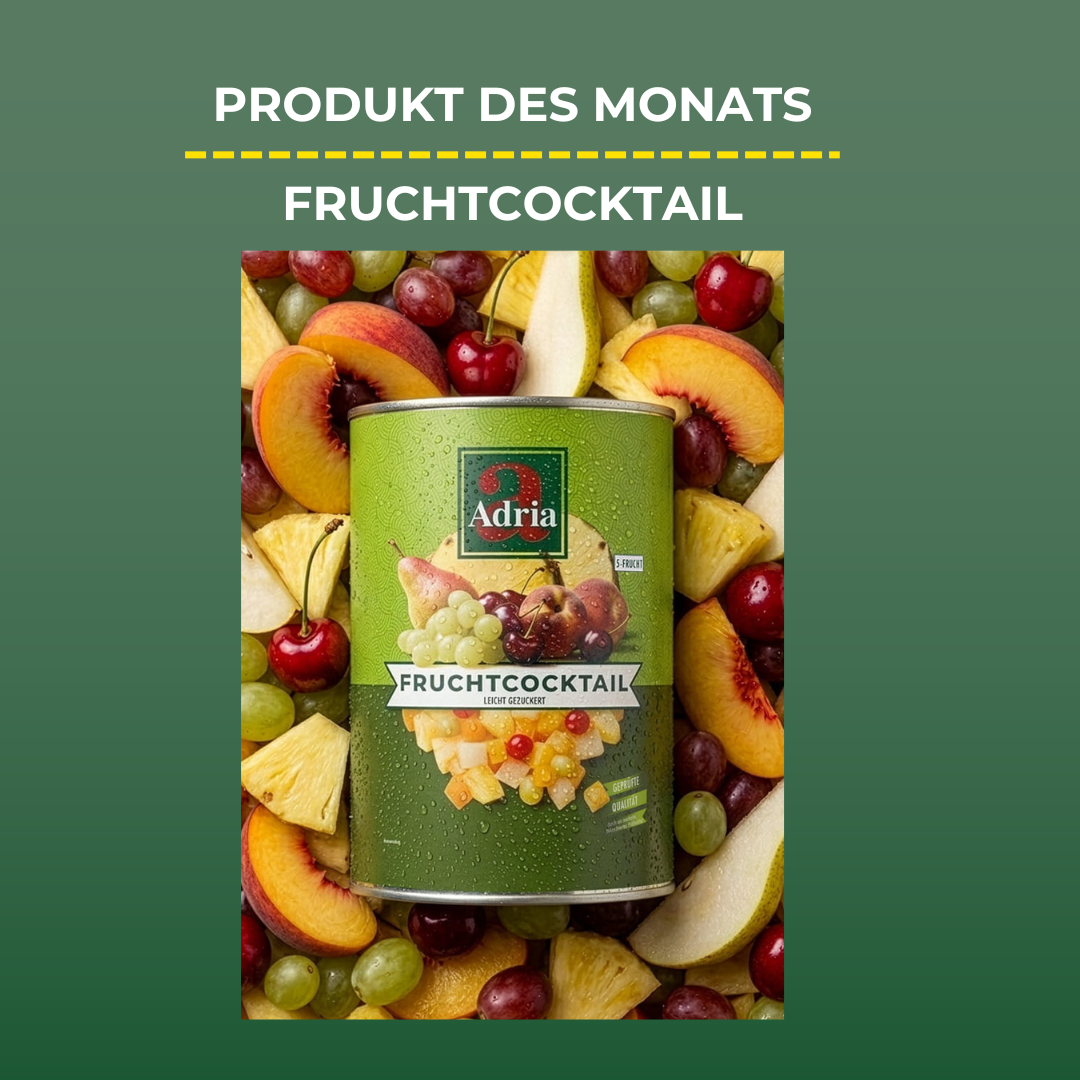
On our new Adria website, we feature a different product each month—complete with fascinating background information. In June, it’s the Adria Lightly Sweetened Fruit Cocktail. It not only brings a touch of summer to your plate, but also adds fruity freshness to buffets, dessert menus, and breakfast tables. Pineapple, pears, grapes, cherries, and peaches are harmoniously combined, ready to use right away, and provide moments of summery enjoyment in the blink of an eye.
Whether for quark-based dishes, ice cream sundaes, or creative desserts—this fruit cocktail impresses with its consistent quality, is easy to portion, and is ideal for professional use in restaurants, hotels, and institutional food service. It is available in package sizes of 500 g, 1,500 g, and 3,000 g drained weight, making it suitable for a wide range of everyday kitchen needs.
Are you looking for an exotic alternative? Then try the Adria Tropical Fruit Cocktail with papaya, pineapple, guava, and passion fruit (1,840 g drained weight).
More information on our website we-love-adria.com.
The tuna in this product comes from a fishery that meets the MSC standard for environmental sustainability. This means that it minimizes its impact on the ecosystem, is well-managed, and preserves fish stocks for the future.
For more information, please visit msc.org.
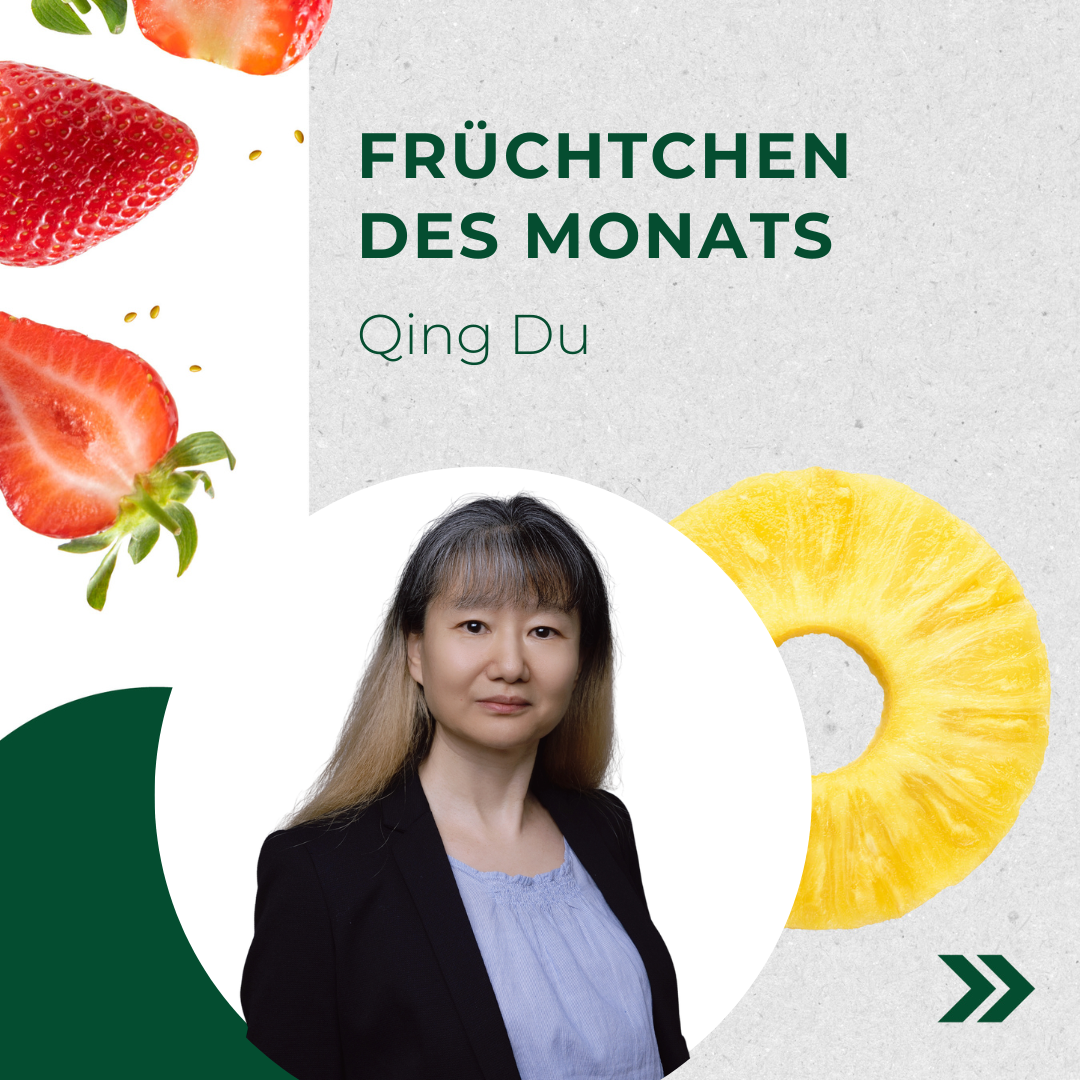
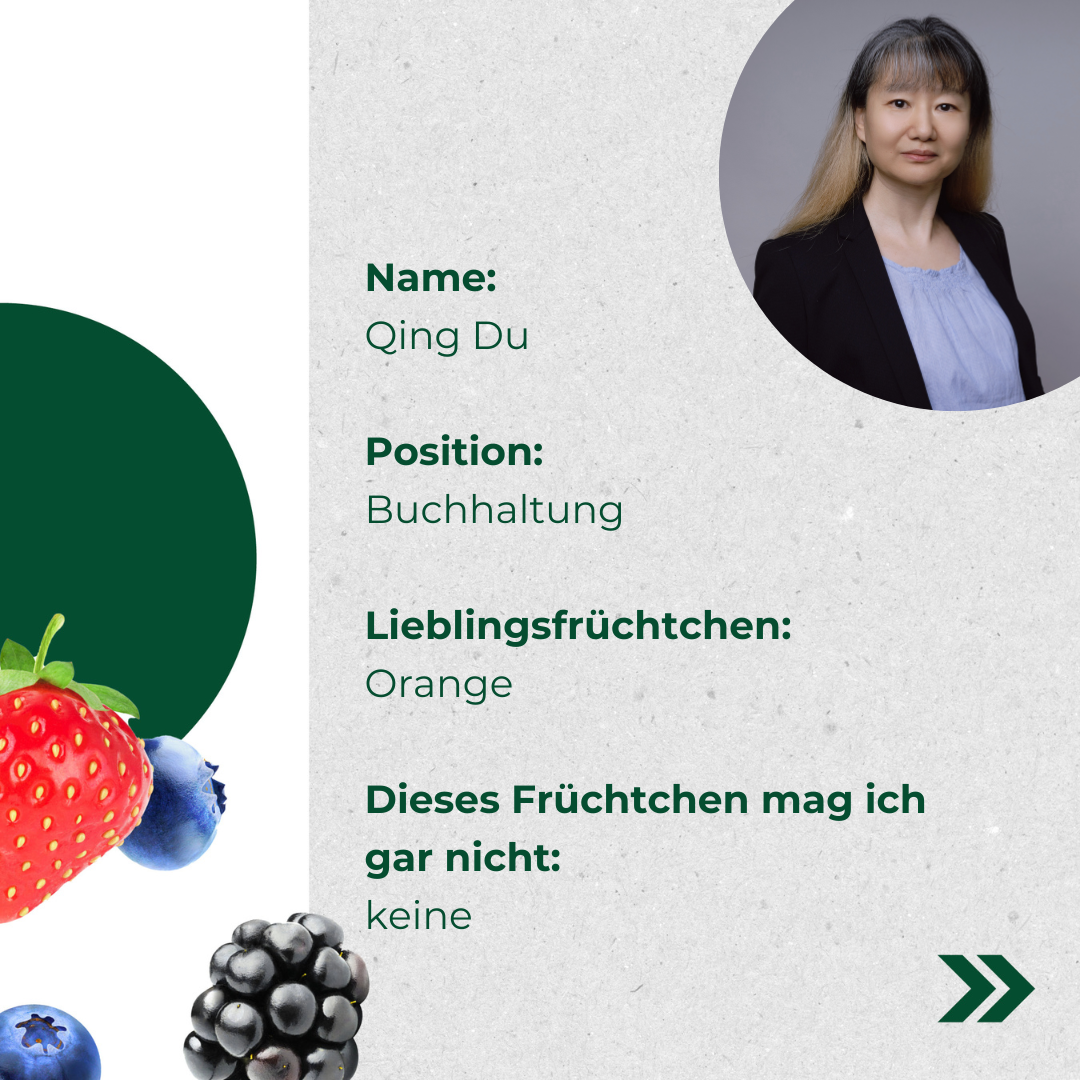
Paul M. Müller’s team continues to grow: Qing Du is now assisting Isabella Gambs in the accounting department. The Munich-based accountant brings extensive experience from her previous role. The food industry is a new environment for her, one she is approaching with great openness. The company culture was a key factor in her decision to join: „I feel very comfortable here—Paul M. Müller is like one big family,“ says Qing Du. In her new role, she hopes to contribute her expertise in a targeted way while also gaining new perspectives: „I’m looking forward to sharing my accounting experience and getting to know the food industry better.“ Welcome, Qing!
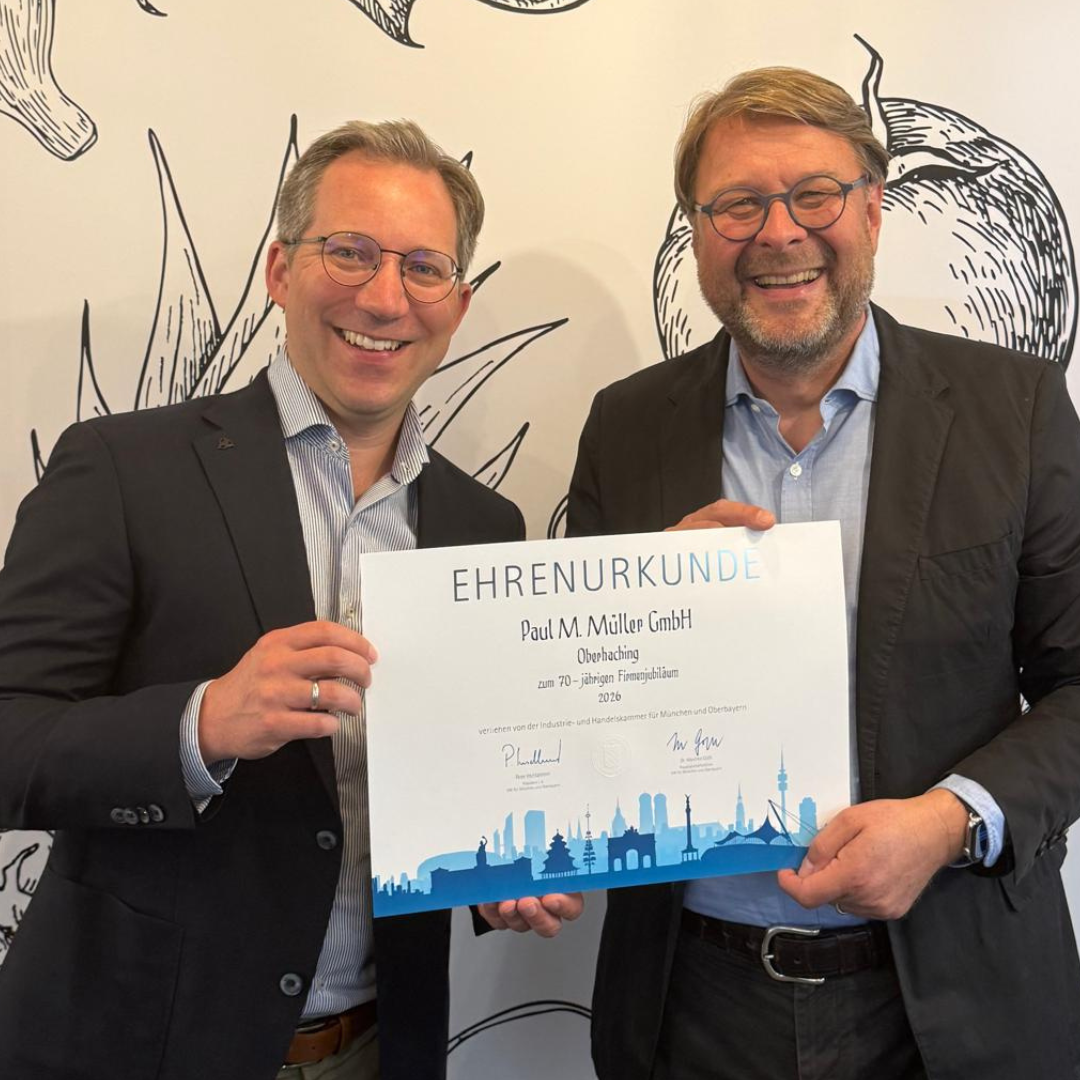
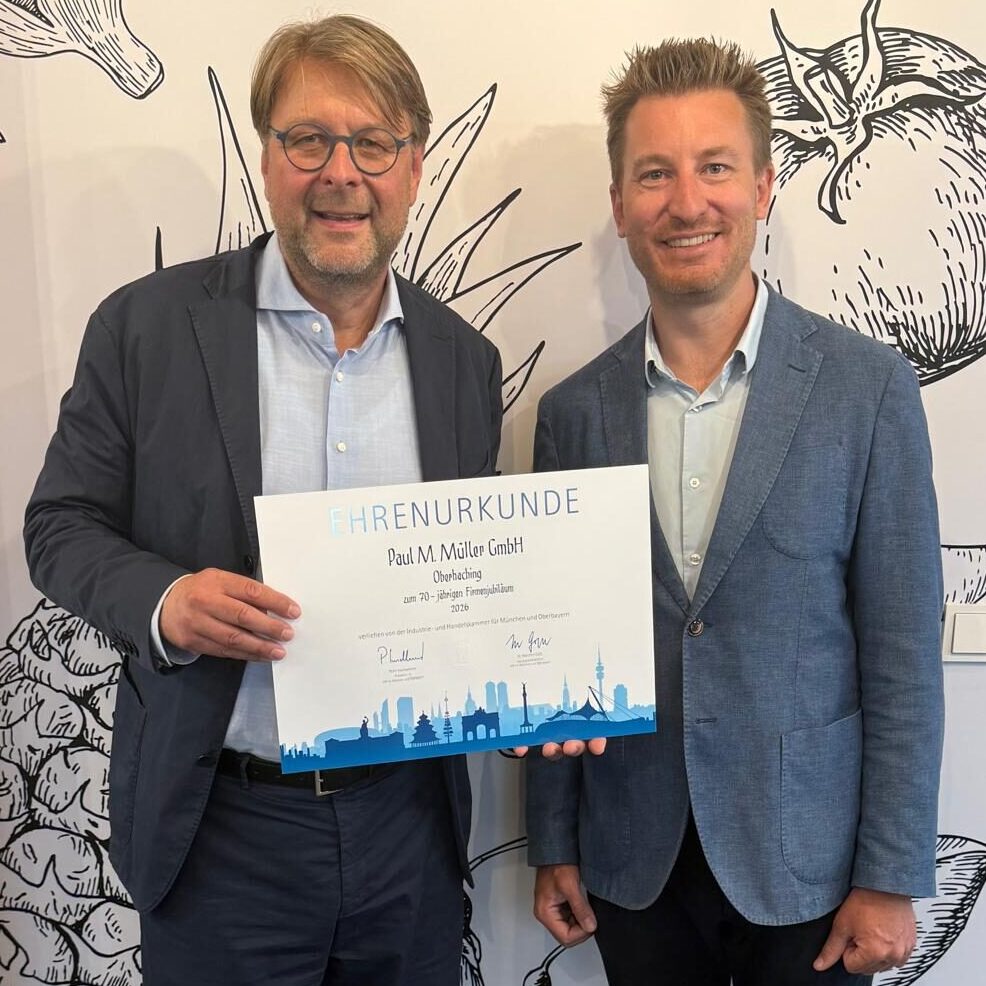
A special anniversary and a special honor: Our managing directors, Thomas Schneidawind (right) and Fabian Kretschmer, were presented with an anniversary certificate by the Chamber of Industry and Commerce (IHK) for Munich and Upper Bavaria. With this certificate, the IHK recognizes Paul M. Müller’s 70th anniversary.
„Since our founding, markets, products, supply chains, and the world in which we operate have changed fundamentally. What has remained are values such as courage, reliability, and the joy of building something together. This anniversary therefore fills me above all with gratitude—toward the people who built this company, and toward our employees, customers, suppliers, and partners who have accompanied and shaped Paul M. Müller over many years,“ says Thomas Schneidawind. Fabian Kretschmer adds: „Especially in a time when conditions are changing at an ever-faster pace, these values are more important than ever. We want to continue building on them in the years to come.“
Rising costs, changing markets, new demands: The food industry is constantly facing challenges. At the same time, companies are demonstrating just how dynamically they can operate. This fascinates and inspires us—and was the impetus for our new interview series.
We’re talking with influential entrepreneurs and decision-makers who look to the future with confidence, recognize opportunities, and are actively shaping the industry’s future. We’re kicking things off with Johannes Dettendorfer from Spedition Dettendorfer. What excites him most about his industry right now? What ideas or innovations inspire him? How does he think we can learn from change? And what does he hope for the future? Johannes Dettendorfer will reveal all of this soon in an interview. If you follow us on LinkedIn or Instagram ...is always well informed.
Do you also have a positive outlook on the future and are willing to share it with others? If so, we look forward to hearing from you—please feel free to send us a short message at info@paulmmueller.com.

Although we consider the sources we use to be reliable, we accept no liability for the completeness and accuracy of the information provided here.
You want to tell us a story or share experiences from the industry? Do you have feedback for us? Photos or stories? We would like to invite you to actively shape the PMM Market Report, and we welcome every contribution, suggestion and criticism. THANK YOU for taking the time to read and be a part of our PMM community.
We provide you with fresh industry news and informative interviews - just enter your name and e-mail address and click on "Subscribe"!
you can reach us Monday - Friday from 7:30 - 17:00.