September 2026 issue

24.09.2026

„It is not the wind, but the sail that determines the direction.“

While the Oktoberfest opened its gates in Munich again a few days ago and millions of people flock through the festival tents, a completely different figure is causing a stir: the leading economic research institutes apparently want to significantly raise their growth forecast for Germany. Instead of the previous 0.6 percent, they now expect gross domestic product to increase by 1.3 percent this year. For the coming year, they expect growth of 1.1 percent.

The figures are still preliminary; the joint economic forecast will not be officially presented until today, Thursday. But should the projection be confirmed, it would be a remarkable signal for the German economy. I therefore view the increased forecast as a bombshell—and as a remarkable counterweight to all the setbacks that have recently (and repeatedly) been the talk of the town.

That is precisely what my co-managing director Fabian Kretschmer and I have discussed quite often over the past few days: Why is a country about which we have been reading mostly worrisome reports for months economically more robust than the headlines suggest? My answer to that: Resilience is not shown by favorable external conditions. It is shown by how quickly one adapts to bad ones.

This applies in particular to our industry – and you don't have to look far to see it. At the Oktoberfest, hundreds of thousands of orders, deliveries, and logistics chains come together smoothly every day, even though the weather, supplies, and crowds vary from day to day. At Paul M. Müller, too, we cannot prevent crop failures due to drought, dictate freight rates, or resolve geopolitical tensions. What we can influence is how early we recognize a development, how openly we inform our customers when delivery times shift, and how quickly our team finds an alternative when the original plan is no longer viable.

That sounds unspectacular. Most of the time, it is. But it is precisely the work that happens in the background while the big headlines are being written elsewhere—and which ultimately decides whether a delivery arrives or not. Perhaps that is the real insight behind the current gross domestic product forecasts: even in an environment with noticeable headwinds, it is possible to stay on course—if enough people are willing to trim their sails accordingly.

With that in mind, I wish you an enjoyable read of our current Food News – featuring developments in the raw material markets and everything that is currently moving our industry.

Sincerely
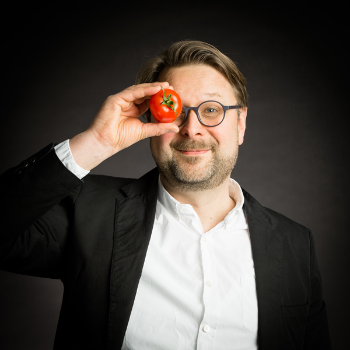
Your Thomas Schneidawind & the Paul M. Müller team

Mandarins:

Mixed forecasts

The mandarin harvest in China is imminent. Initial forecasts indicate that yields in the Zhejiang region will be three to five percent lower compared to 2025. The harvest in the Hubei and Hunan provinces is also expected to decline by around five to eight percent. According to our expert, canned mandarins are likely to account for about 15 percent of total production. This corresponds to a volume of 500,000 to 600,000 metric tons. Of this amount, approximately six percent is exported. Around 25 percent of these exports go to the US, while Germany accounts for about three percent. As a result, the US market remains an important influencing factor for price trends in export goods. However, due to existing trade tensions, an increase in export demand is currently not expected. Accordingly, no major price increases for Chinese goods are anticipated at present.

Due to the hot summer, mandarin production in Turkey will start earlier than usual. In Adana, our expert expects yields to be 10 to 15 percent lower than the previous year, whereas everything looks stable in the Izmir region. Even though the raw material price has not yet been fixed, price increases are likely—primarily due to rising fuel prices. However, higher wages and packaging material costs are also driving up prices. Although the Turkish lira has currently lost about 15 percent of its value against the euro, which initially creates a cost-damping effect from a currency perspective, this is significantly outweighed by Turkey's continued high inflation of an official 31.5 percent, or around 45 percent real inflation according to our expert's assessment. Overall, therefore, further rising costs are to be expected despite the positive currency effect.

Olives:

Positive forecasts from Spain

The outlook for Spanish olives is generally good. The stocks show high yield potential, and the trees and fruit are healthy. However, our local expert emphasizes: „How the weather develops into the first weeks of October is now crucial.“ Following a severe heat wave in September, sufficient rainfall is now important to secure size and yield. Overall, experts expect a significantly improved availability of Spanish goods this season. A remaining challenge, however, is the limited availability of labor during the short harvest window.

Peppers and hot peppers:

Differences depending on the variety

For our popular pepper products, we use the traditional „Lombardi“ variety. It is compelling due to its good processing properties, texture, and flavor. However, one disadvantage is becoming increasingly significant: the variety is not resistant to certain viruses and other plant diseases. In addition, Lombardi peppers are difficult to cultivate in the same location for more than two to three years without suffering yield losses. As a result, farmers in Turkey are becoming less willing to cultivate Lombardi peppers. This season, yields in the already limited cultivation areas are also severely reduced because it rained heavily during planting. As a consequence, raw material prices for Lombardi peppers in Turkey are currently up to 50 percent higher than usual. The extent to which goods from Egypt are an option remains to be seen. No concrete figures are available on this yet.

The cultivation areas for the Capia and Topa bell pepper varieties in Turkey are at the previous year's level. While production for Capia has been completed largely without major incidents, the Topa variety is showing significantly lower yields—estimated by our expert to be around 30 percent below expectations. Overall, however, the market currently appears calm and balanced. Existing contract prices should remain stable as long as the current supply and demand ratio continues.

Tomatoes:

Harvest and production at a glance

Tomato harvesting and production are in full swing. We take a look at the various producer countries.

In northern and southern Italy, harvesting began about ten days earlier than usual in July due to high temperatures. Since then, the season has been progressing on schedule and without major disruptions from hail or storms. The Brix content is high due to the hot climate. However, one of our local partners reports that the fruit is ripening somewhat unevenly in places, which could reduce the overall yield. How total volumes will develop in the remaining weeks of production until the end of September (in northern Italy) and early October (in southern Italy) remains to be seen. No specific statements can be made at this time, particularly regarding the late tomato varieties in southern Italy.

In Portugal, quality and quantity currently align with expectations. In Spain, on the other hand, there seem to be losses in quality. Exact figures from both countries are still pending.

We already have the first figures from China. Due to the heat and drought of the past two months, during which temperatures rose above 40 degrees, the tomato harvest is lower than expected. While 700,000 metric tons of raw product were initially discussed at the beginning of the season, a maximum of 600,000 metric tons is currently expected. For comparison: In good years, yields of around 1 million metric tons have been achieved.

Pineapples:

Delayed start of the winter harvest

Following the end of the summer pineapple harvest in Thailand and the subsequent closure of factories, these are now reopening just in time for the onset of the winter harvest. However, the Thai Food Processors' Association (TFPA) expects an initially tight supply. As of September 15, 2026, projected volumes are 24,100 metric tons in September, 54,300 metric tons in October, 101,300 metric tons in November, and 120,500 metric tons in December. This would bring the total winter harvest to 300,200 metric tons—38,300 metric tons above previous forecasts. The price currently stands at 9.50 to 10.50 THB per kilogram of raw material. With the start of production by additional processors, price pressure is also expected to increase. In addition, rising demand from October onwards, the exchange rate, and higher packaging costs could influence price developments.

Due to rising raw material prices for pineapples, some farmers plan to convert their cultivation areas from other fruits to pineapple production next year. However, the extent to which this will actually lead to an increased supply remains to be seen, as the effects of El Niño are also expected to impact yields in 2027.

Tuna:

Catches remain low

Poor catches, low raw material volumes, rising prices. This summarizes the situation in the tuna market. Despite the end of the FAD ban on August 15 in the Western and Central Pacific, catches there remain low. The primary cause is believed to be the effects of El Niño, as this weather phenomenon alters water temperatures, currents, and the distribution of nutrients and forage fish in the Pacific. The habitats and migration routes of tuna are therefore also changing – and with them the availability for tuna fishing. Thai processors are consequently increasingly turning to raw material from other fishing regions. In the first half of the year, around 37,000 metric tons of skipjack were imported from the Indian Ocean. Increased fuel prices are causing additional cost pressure by making fishing, transport, refrigeration, and processing more expensive. In numbers, this means: In Bangkok, transactions for frozen skipjack were already reported at around USD 2,100 per metric ton at the beginning of September. This corresponds to an increase of 5 percent compared to the end of August. Over the course of the month, raw material prices rose even further – namely to around USD 2,400 per metric ton in Bangkok and USD 2,300 per metric ton in Ecuador (as of September 23, 2026). Consequently, the raw material price is currently at the same record level as back in 2009. The catches in the coming weeks will now be crucial for the further price development.


„When I introduce new software, I have the opportunity to rethink things as well.“

– Axel Lehnen
Artificial intelligence and digital solutions are transforming the food industry. Paul M. Müller discusses the opportunities that arise from this and where there is still room for improvement with Axel Lehnen from Aptean. The provider of industry-specific enterprise software works with integrated AI solutions and is based in Ettlingen.

Mr. Lehnen, looking at the food industry: Which tech trends will particularly shape the sector in the coming years?
Clearly, artificial intelligence as a technology and specific AI functions. They will have a major impact in many industries – including, of course, the food sector. An important topic is traceability, for example: from harvest to the finished product. Especially in the food industry, it must be traceable where a product or raw material comes from and the path it has taken – and this can support quality management. Cold chains can also be monitored digitally. Through digitization and AI, companies increasingly have the opportunity to bring together data from different environments and map processes in an automated way.

So AI is already a big topic. How well-positioned is the food industry when it comes to digitalization in general?
Like in many other industries, people were rather reticent. This certainly also has to do with investment uncertainty. Many companies waited a long time when it came to new technologies and system environments. This starts with the fundamental question: Do I have my own server in the company, do I have it operated by a provider, or do I go into the cloud? The willingness to digitize is there, but implementation was often still hesitant. Therefore, there is definitely some catching up to do, even if companies shy away from the necessary investments.

Where do you think companies should start first?
An important point is to streamline processes and fundamentally question them. Do I constantly have to train employees in the same manual workflows? Or can I automate certain processes? A software transition in particular offers the opportunity to look at every process step and ask: Is this still necessary, or can it be done differently? In addition to a willingness to invest, this requires human resources and the support of management.

Which processes are still done manually today, even though there has long been a better way?
A good example is sales. Orders reach a company through very different channels: a customer calls, an order arrives by email, or already as a structured data set via an interface. Such processes can increasingly be automated using AI. An AI agent can process the incoming information and generate an order from it – all the way to further processing and invoicing.

When such routine tasks are eliminated, concerns quickly arise that fewer staff will be needed as well...
Of course, this allows us to save resources. For me, however, the decisive factor is that employees are relieved of repetitive tasks and have more time for more important duties. Entering an order, for example, can be automated, but the control function remains with the human. Employees still need to check and take into account special circumstances that the system cannot know. Manual data entry decreases, while professional oversight remains.

Especially in view of the shortage of skilled workers, this relief could be an important factor, couldn't it?
Definitely. From my perspective, that is one of the major levers. Particularly against the backdrop of the skilled labor shortage, it is important to relieve employees of manual routine tasks. This allows them to focus more on tasks where their experience and professional expertise are required. For me, it is not about replacing humans with technology, but rather meaningfully supporting their work.

For such automated processes to work, an appropriate database is required. What role do data play today along the value chain?
Data is the be-all and end-all—regardless of whether we are talking about automation, digitization, or AI. If the necessary data is not available, the process cannot work either. Therefore, information from different systems should be consolidated as centrally as possible. This is important, for example, for reporting, quality management, or traceability. In the past, much of the information was still maintained manually in Excel spreadsheets. We should move away from that. A software migration is therefore also a good opportunity to clean up: An ERP system is often used for five to ten years, and during this time, data inevitably accumulates that is no longer needed at some point. I call them „dead files.“ That is why we take a close look during a migration: Where is the data located? Is it still up to date? Which ones do we really need? This is the chance to get rid of data junk and reorganize structures.

And presumably, a lot of things will be found that are not in the central system at all, but rather in the employees' own Excel lists?
Yes. As a consultant, for example, I like to look at the employees' Excel lists. You frequently notice that information is also maintained manually. Perhaps the colleague at the desk next to them is even maintaining a similar list. Then the question arises: Why are we maintaining this information multiple times and can't we map it centrally in the system?

All of that costs money to begin with. How do you experience the willingness to invest in view of the economic uncertainty?
We have been seeing a certain reluctance to invest in many industries for quite some time now. Of course, we as an IT service provider notice this as well. But a quieter phase in particular can be a good time to prepare for future business. Ultimately, being an entrepreneur means deciding, despite uncertainty, when the right time for modernization has come.

Anyone investing today also needs to consider which technologies will truly be relevant tomorrow. In your view, what will occupy us the most in the coming years?
From our perspective, clearly the AI-supported processing of workflows and tasks. We also use such applications ourselves and see how much they can support us. The topic is developing enormously fast. I assume that AI will occupy us massively over the next two to three years. I wouldn't look much further into the future in the IT sector right now. Too much is changing in too short a time for that.

With the multitude of new AI solutions, it is likely difficult for companies to decide what actually makes sense. How do you deal with that?
We are currently confronted with new topics almost weekly. Therefore, we as consultants also have to sort through them: Which of these actually brings added value to a company and which tool suits the respective client? It is not about using AI just because it is currently being discussed everywhere. The application must fit the company and its processes.

A company that is currently taking this path is Paul M. Müller. What exactly is behind this project?
We are assisting Paul M. Müller in reviewing existing processes and mapping them in the best possible way within a new software environment. This includes master data as well as financial accounting, sales, purchasing, production, logistics, and management. Basically, we are taking stock of the company's processes and considering: What is currently in place, and how can we map it better in the future?

What mistake should companies avoid during such a modernization?
It is easy to make something new out of something old. If I introduce new software and adopt all old data and processes one-to-one, I end up with a new user interface, but basically still the same structures. That is why one should take the opportunity and ask to fundamentally question existing procedures instead of simply transferring them into the new system environment. In IT, we also refer to this as a greenfield approach. You start on a greenfield and only adopt what is actually needed. If a company is willing to go down this path and truly question its previous procedures, such a project is also fun.

*central software for controlling and managing a company – such as in the areas of warehousing, sales, finance, purchasing, human resources, or production.

Personal details:
Axel Lehnen is a Senior Project Manager at Aptean and supports companies in the introduction and modernization of enterprise software. In his work, he focuses, among other things, on the optimization and digitalization of business processes as well as the question of how new technologies can be meaningfully integrated into existing workflows. Currently, he and his project team are supporting Paul M. Müller in the transition to Microsoft Dynamics 365 Business Central in combination with the F&B solution from Aptean.

Tense freight market:

Strain on logistics

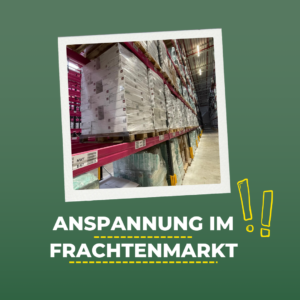
The road freight transport market remains tight. High fuel costs, rising operating costs, the ongoing driver shortage, and geopolitical tensions are impacting transport prices and freight capacity availability. There is currently no relief in sight. In logistics, this means not only rising transport costs but also increasingly challenging planning of goods flows.

A major cost driver remains the price of diesel, as it has a direct impact on freight forwarders' calculations. The Federal Association for Freight Transport, Logistics and Waste Disposal (BGL) also points to a continuing burden caused by high diesel prices.
The structural shortage of drivers is further exacerbating the situation: according to the BGL, Germany is short of around 120,000 truck drivers – and the trend continues upward. The discontinuation of driver training in the German Armed Forces, as well as the high costs for a driver's license and professional driver qualification amounting to around 7,500 euros to over 10,000 euros, make it difficult to recruit new talent for the industry. As a result, transport capacities remain limited – making short-term available cargo space difficult to find, especially in times of higher demand or seasonal peaks.

The situation is similar for sea freight. Although maritime traffic through the Suez Canal is recovering, it remains well below the pre-crisis level in the Red Sea. This is also shown by Lloyd's Red Sea Transit Monitor: In August 2026, a mere 184 container transits were registered, compared to 549 in August 2023. At the same time, some major shipping companies are returning to the Suez route. Maersk and Hapag-Lloyd have already announced additional container services via the Red Sea for the coming weeks. However, since the security situation remains volatile, further detours are still possible.

For the coming months, proactive transport planning therefore remains crucial. Early coordination with logistics partners and securing required transport capacities as far in advance as possible can help avoid short-term bottlenecks and additional costs. With our team, we are ideally positioned, keep an eye on the situation, and find suitable solutions.
Product of the month:

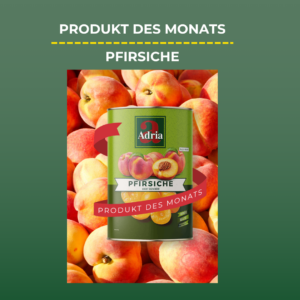
Adriatic peaches

A piece of summer on the plate: Hardly any fruit represents sunny days quite like the peach. Exactly why Adria peaches are our product of the month in September. With their fruity-sweet aroma and juicy flesh, they make breakfast buffets, dessert menus, and sweet classics all-around perfect. For decades, Greece has been one of the most important cultivation and processing locations for peaches in Europe and boasts a long tradition in the production of canned peaches. Our Adria peaches—available as peach halves, slices, or dices—are offered with a drained weight of 480 g, 1,500 g, 2,400 g, or 3,000 g.

Did you know? The famous Peach Melba dessert was created in the early 1890s by the French star chef Auguste Escoffier at London's Savoy Hotel in honor of the Australian opera singer Nellie Melba. Along with banana splits and „Hot Love“ (Heiße Liebe), it still evokes fond childhood memories for many to this day. So why not reinterpret these classics with our Adria peaches?

More information on our website we-love-adria.com.
Fruit of the Month:

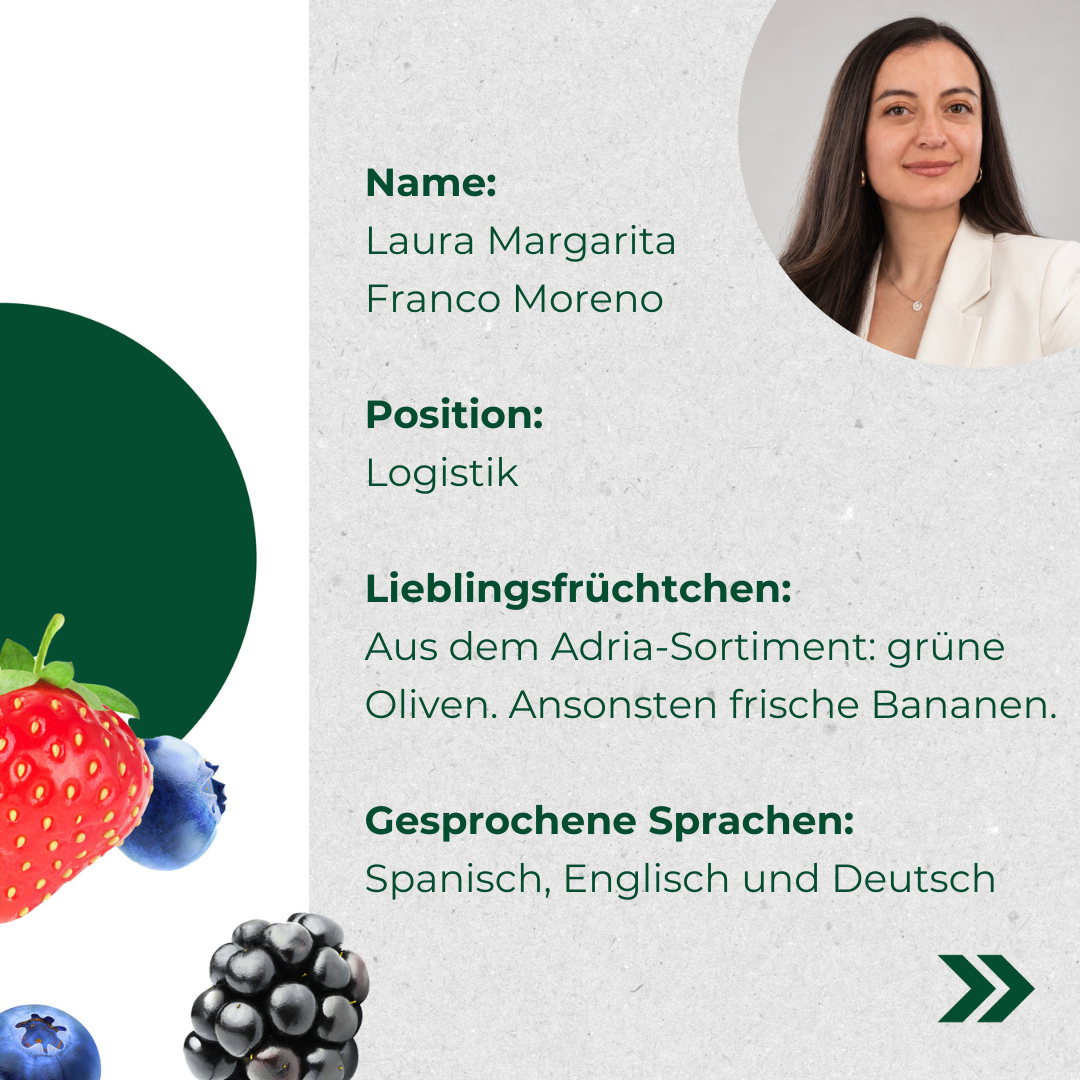
Laura Margarita Franco Moreno

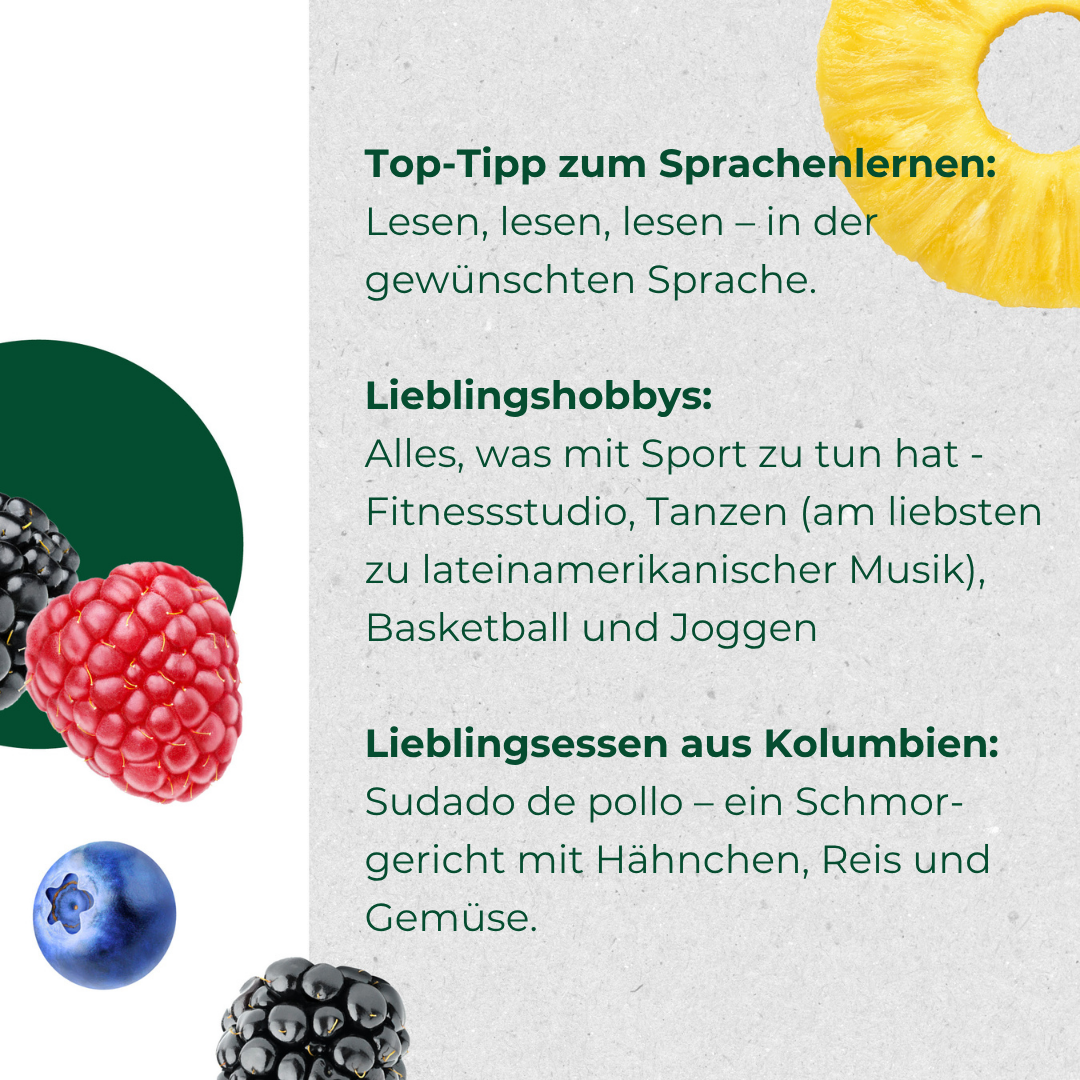
Since July, Laura Margarita Franco Moreno has been enriching our logistics team and is responsible for ensuring that the desired goods reach our customers at the right time. Laura temporarily had to leave Paul M. Müller because her residence permit was not renewed in time by the Munich Kreisverwaltungsreferat. But beyond that, her journey to us is both exciting and inspiring: five years ago, Laura completed her degree in hotel and tourism management in Colombia and moved to Germany. Here she worked for a year as an au pair and then as part of a Voluntary Social Year (FSJ) in a kindergarten for children with disabilities. In the process, she learned German—so well that she subsequently completed a training program as a freight forwarding and logistics services clerk. „Logistics affects all businesses and areas. So it was a great fit as further training for my studies,“ Laura says. Now—three years later—we are delighted that she is part of our team.

High protein is trending

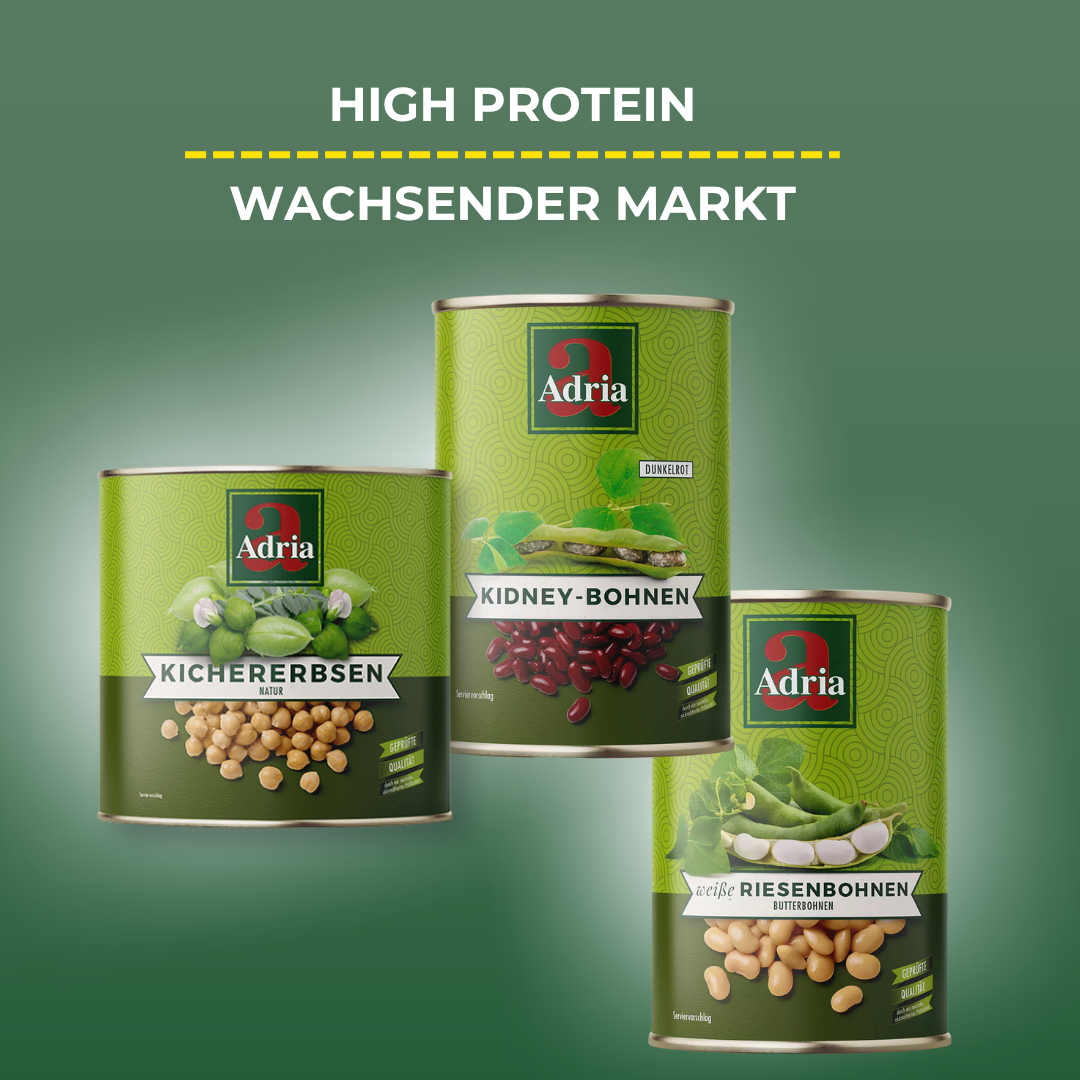
High protein is trendy. With their high protein content, legumes were simply ahead of their time. A current YouGov analysis shows: The market for high-protein products is growing by 39.1 percent year-on-year. Already 48 percent of German consumers buy foods labeled „high protein“ or „protein-rich.“ Among Generation Z (birth years 1997 to 2012), it is as high as 75 percent. Yet a protein-rich diet does not always require specially fortified products. Many foods naturally provide valuable plant-based protein. Chickpeas, kidney beans, and white beans are therefore currently experiencing a true comeback. At Adria they have been part of our product range for many years. They are versatile and fit perfectly into bowls, salads, soups, curries, or Mediterranean dishes. We are happy to advise you on the right products for your requirements.
Optimism for the Future:

Continuously rethink own concepts and the existing product range

„The hospitality industry is incredibly resilient. In a time of countless regulations, growing bureaucracy, and a strained economic situation, it proves that it defies many challenges and keeps fighting, says Erwin Erb in our Interview series „Courage for the future.“ Continually rethinking one's own concepts and existing product range—the managing director of Miesbacher Gastroservice GmbH sees these as two key success factors. In the interview, he also reveals which innovations are currently gaining importance for him and what makes him optimistic.

Do you also have courage for the future and a story you would like to share with us? Then write to us at info@paulmmueller.com – we look forward to hearing from you!

Although we consider the sources we use to be reliable, we accept no liability for the completeness and accuracy of the information provided here.

PMM Community

You want to tell us a story or share experiences from the industry? Do you have feedback for us? Photos or stories? We would like to invite you to actively shape the PMM Market Report, and we welcome every contribution, suggestion and criticism. THANK YOU for taking the time to read and be a part of our PMM community.

Your from Paul M. Müller

Market report by mail

We provide you with fresh industry news and informative interviews - just enter your name and e-mail address and click on "Subscribe"!

image/svg+xml

HIer's the
Paul M. Müller
Food News

We provide you with fresh industry news and informative interviews - just enter your name and e-mail address and click on "Subscribe"!

Contact

In Person

you can reach us Monday - Friday from 7:30 - 17:00.