Mr. Lehnen, looking at the food industry: Which tech trends will particularly shape the sector in the coming years?
Clearly, artificial intelligence as a technology and specific AI functions. They will have a major impact in many industries – including, of course, the food sector. An important topic is traceability, for example: from harvest to the finished product. Especially in the food industry, it must be traceable where a product or raw material comes from and the path it has taken – and this can support quality management. Cold chains can also be monitored digitally. Through digitization and AI, companies increasingly have the opportunity to bring together data from different environments and map processes in an automated way.
So AI is already a big topic. How well-positioned is the food industry when it comes to digitalization in general?
Like in many other industries, people were rather reticent. This certainly also has to do with investment uncertainty. Many companies waited a long time when it came to new technologies and system environments. This starts with the fundamental question: Do I have my own server in the company, do I have it operated by a provider, or do I go into the cloud? The willingness to digitize is there, but implementation was often still hesitant. Therefore, there is definitely some catching up to do, even if companies shy away from the necessary investments.
Where do you think companies should start first?
An important point is to streamline processes and fundamentally question them. Do I constantly have to train employees in the same manual workflows? Or can I automate certain processes? A software transition in particular offers the opportunity to look at every process step and ask: Is this still necessary, or can it be done differently? In addition to a willingness to invest, this requires human resources and the support of management.
Which processes are still done manually today, even though there has long been a better way?
A good example is sales. Orders reach a company through very different channels: a customer calls, an order arrives by email, or already as a structured data set via an interface. Such processes can increasingly be automated using AI. An AI agent can process the incoming information and generate an order from it – all the way to further processing and invoicing.
When such routine tasks are eliminated, concerns quickly arise that fewer staff will be needed as well...
Of course, this allows us to save resources. For me, however, the decisive factor is that employees are relieved of repetitive tasks and have more time for more important duties. Entering an order, for example, can be automated, but the control function remains with the human. Employees still need to check and take into account special circumstances that the system cannot know. Manual data entry decreases, while professional oversight remains.
Especially in view of the shortage of skilled workers, this relief could be an important factor, couldn't it?
Definitely. From my perspective, that is one of the major levers. Particularly against the backdrop of the skilled labor shortage, it is important to relieve employees of manual routine tasks. This allows them to focus more on tasks where their experience and professional expertise are required. For me, it is not about replacing humans with technology, but rather meaningfully supporting their work.
For such automated processes to work, an appropriate database is required. What role do data play today along the value chain?
Data is the be-all and end-all—regardless of whether we are talking about automation, digitization, or AI. If the necessary data is not available, the process cannot work either. Therefore, information from different systems should be consolidated as centrally as possible. This is important, for example, for reporting, quality management, or traceability. In the past, much of the information was still maintained manually in Excel spreadsheets. We should move away from that. A software migration is therefore also a good opportunity to clean up: An ERP system is often used for five to ten years, and during this time, data inevitably accumulates that is no longer needed at some point. I call them „dead files.“ That is why we take a close look during a migration: Where is the data located? Is it still up to date? Which ones do we really need? This is the chance to get rid of data junk and reorganize structures.
And presumably, a lot of things will be found that are not in the central system at all, but rather in the employees' own Excel lists?
Yes. As a consultant, for example, I like to look at the employees' Excel lists. You frequently notice that information is also maintained manually. Perhaps the colleague at the desk next to them is even maintaining a similar list. Then the question arises: Why are we maintaining this information multiple times and can't we map it centrally in the system?
All of that costs money to begin with. How do you experience the willingness to invest in view of the economic uncertainty?
We have been seeing a certain reluctance to invest in many industries for quite some time now. Of course, we as an IT service provider notice this as well. But a quieter phase in particular can be a good time to prepare for future business. Ultimately, being an entrepreneur means deciding, despite uncertainty, when the right time for modernization has come.
Anyone investing today also needs to consider which technologies will truly be relevant tomorrow. In your view, what will occupy us the most in the coming years?
From our perspective, clearly the AI-supported processing of workflows and tasks. We also use such applications ourselves and see how much they can support us. The topic is developing enormously fast. I assume that AI will occupy us massively over the next two to three years. I wouldn't look much further into the future in the IT sector right now. Too much is changing in too short a time for that.
With the multitude of new AI solutions, it is likely difficult for companies to decide what actually makes sense. How do you deal with that?
We are currently confronted with new topics almost weekly. Therefore, we as consultants also have to sort through them: Which of these actually brings added value to a company and which tool suits the respective client? It is not about using AI just because it is currently being discussed everywhere. The application must fit the company and its processes.
A company that is currently taking this path is Paul M. Müller. What exactly is behind this project?
We are assisting Paul M. Müller in reviewing existing processes and mapping them in the best possible way within a new software environment. This includes master data as well as financial accounting, sales, purchasing, production, logistics, and management. Basically, we are taking stock of the company's processes and considering: What is currently in place, and how can we map it better in the future?
What mistake should companies avoid during such a modernization?
It is easy to make something new out of something old. If I introduce new software and adopt all old data and processes one-to-one, I end up with a new user interface, but basically still the same structures. That is why one should take the opportunity and ask to fundamentally question existing procedures instead of simply transferring them into the new system environment. In IT, we also refer to this as a greenfield approach. You start on a greenfield and only adopt what is actually needed. If a company is willing to go down this path and truly question its previous procedures, such a project is also fun.
*central software for controlling and managing a company – such as in the areas of warehousing, sales, finance, purchasing, human resources, or production.
Personal details:
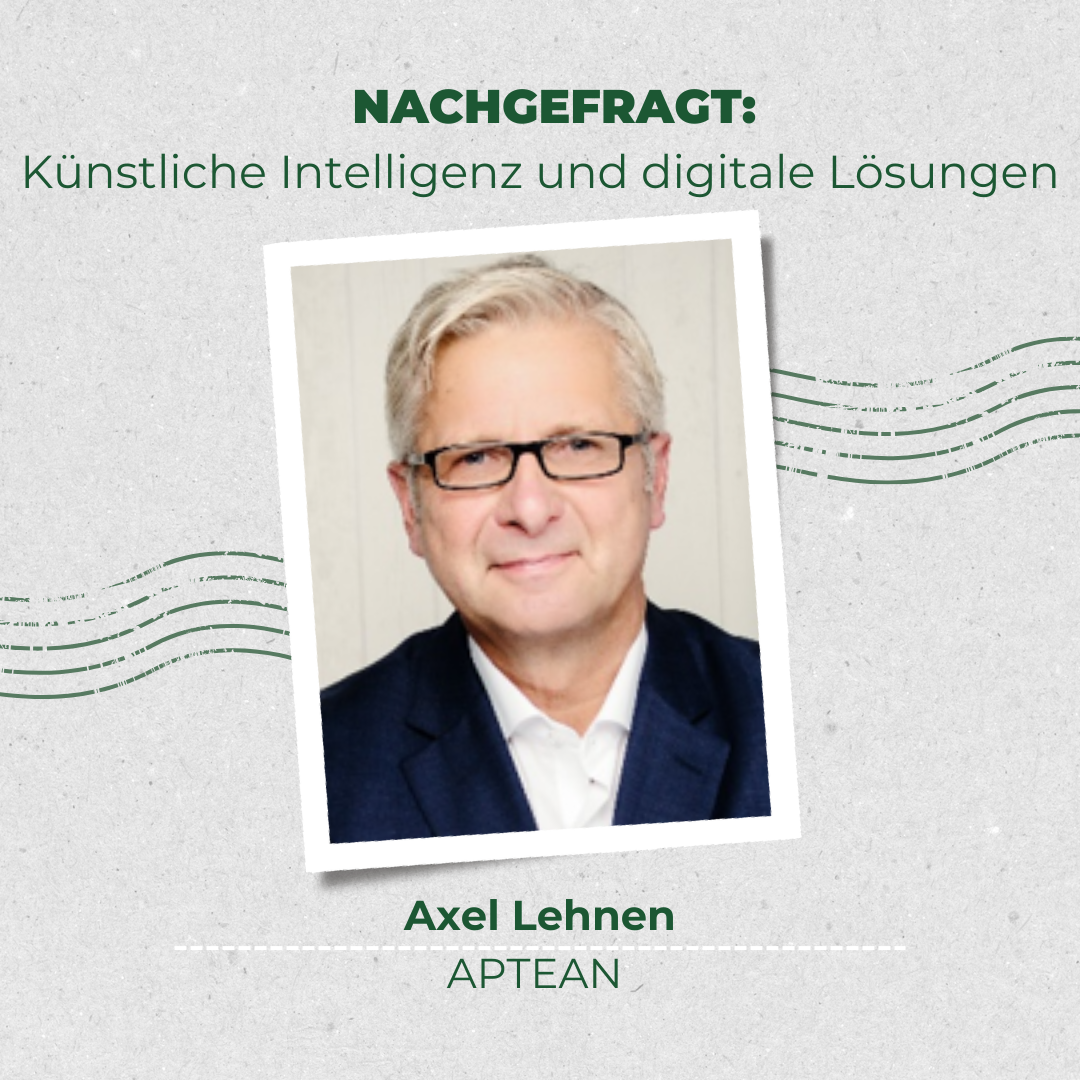
Axel Lehnen is a Senior Project Manager at Aptean and supports companies in the introduction and modernization of enterprise software. In his work, he focuses, among other things, on the optimization and digitalization of business processes as well as the question of how new technologies can be meaningfully integrated into existing workflows. Currently, he and his project team are supporting Paul M. Müller in the transition to Microsoft Dynamics 365 Business Central in combination with the F&B solution from Aptean.
you can reach us Monday - Friday from 7:30 - 17:00.