Ms. Weidner, food trucks have been experiencing a boom for years. What do you think makes this model so successful?
The biggest advantage is our mobility - and therefore flexibility. Food trucks are not tied to one location. We can decide for ourselves which orders we accept, where we go and how we adapt our offer. Ideally, a food truck is a changing concept that can be quickly adapted to different requirements using modular systems. This flexibility clearly sets us apart from stationary restaurants. I had direct access to the food truck world early on through my father, who ran food trucks himself. During the first coronavirus lockdown, I experienced first-hand how many trucks suddenly found themselves without orders - each one on its own, without any structure or exchange. This is exactly what gave rise to the idea of networking food trucks more closely and pooling them professionally.
For those who don't know you yet: How is your model actually structured?
We focus exclusively on food truck catering for companies - in other words, on plannable events such as summer parties, staff events or Christmas parties. We deliberately do not cater for festivals or public day-to-day business. If a company is planning an event, for example for 200 or 1,000 people, a central request comes to us. We play this request out to our network of over 160 food trucks throughout Germany.
What does this model mean for organization, merchandise planning and purchasing?
The number of guests is determined in advance and the dates are clearly defined. As a rule, food trucks from the respective region respond. This ensures short distances and bundled operations. For the food trucks - and also for suppliers - this means very good planning. Quantities, shopping lists and delivery requirements can be calculated much better than in traditional day-to-day business.
And what if a customer wants a specific food truck concept?
Franziska Weidner: Then it can also happen that a food truck travels from another region. The additional travel costs are factored in. However, nothing changes in terms of goods logistics: it's still about clearly defined catering quantities, not spontaneous demand.
You also use food trucks as a canteen substitute. How does this work in practice?
We specifically target companies in business parks that do not have their own lunch offer. These volumes are often too small for traditional canteens, but ideal for food trucks. Employees are regularly supplied by such a mobile canteen - on fixed days, with known portion numbers and clear processes. This makes goods planning very efficient.
Are the goods requirements of food trucks very different from those of traditional restaurants?
Yes, clearly. Food trucks rarely work with à la carte business. We know in advance exactly how many portions are needed on which day. This completely changes the purchasing process. Restaurants that are open seven days a week have to react much more to uncertainties. Food trucks can buy more specifically, have smaller menus and have to work very quickly - also because of the limited space.
What role do long-life products and convenience solutions play in everyday food truck life?
A very large one. Planning is particularly important in catering, but there are also a lot of leftovers. Shelf-stable products make it possible to reuse leftovers sensibly and avoid food waste. Many food trucks do not have a warehouse, only garages or cellars. Deliveries several times a week are often not possible. Products must therefore be easy to store and flexible to use.
What criteria do food trucks use to select their products?
It is always a mixture of price, quality, shelf life, container size and flexibility. There are food trucks that attach great importance to quality and always work with the same high-quality products. Others are more price-driven. The decisive factor is that products fit the working reality in the truck and can be used efficiently.
Which product categories are particularly relevant?
Everything that is easy to prepare, store and use quickly - for example sauces, stocks, broths, vegan components or products that can be easily portioned. Drinks also play a major role, especially in catering and mobile canteen supply.
What significance do cans and classic convenience products have?
Cans are extremely practical. They are easy to store, transport and portion. You only open as much as you actually need. This is a great advantage, especially after catering, because leftovers do not have to be disposed of. This improves costing and reduces losses.
Which packaging works less well in the food truck?
Glass is the absolute worst case scenario - it's not an option in a food truck. The risk of breakage, weight and space requirements are too great. Very large containers are also difficult because the storage space is extremely limited.
What do you specifically want from manufacturers and suppliers?
Smaller container sizes and more flexibility. Many food trucks cannot purchase large quantities, but are still relevant customers. Bag-in-box solutions would be ideal because they save space and can be disposed of compactly after emptying. A concrete example would be water in cans. PET is unpopular, glass is impractical. Flexible solutions would be very interesting both for drinks and for use in cooking.
How do food trucks make purchasing decisions?
Very order-related. Fresh produce is purchased for catered events that are easy to plan. For unclear quantities or large events, we tend to use long-life products. It's about adapting the products intelligently to the respective situation.
Has the use of convenience products changed in recent years?
Yes, clearly. The products have improved, especially in the vegan sector. Fresh products also often have a longer shelf life today or can be used more efficiently. This significantly expands the possibilities in the food truck.
What culinary trends do you currently see?
Vegan will continue to grow. At the same time, we are seeing a return to down-to-earth cuisine. It doesn't always have to be the hippest. Baked potatoes are a big topic right now, as are honest meat dishes with clear origins. Quality and transparency are becoming increasingly important. And, of course, appearance also plays a role - food can be „instagrammable“.
Do new food trucks still have a chance despite the competition?
In any case. A food truck is also a useful additional business for stationary restaurateurs. You become more mobile, can cater more easily and reach new target groups. Products that are not sold in the food truck can often be reused in the restaurant - and vice versa.
You work in a very traditional industry. How do you experience this as an entrepreneur?
Having the courage to do things differently pays off - even if you fall down from time to time. In a traditional industry in particular, sometimes it is precisely this step forward that is needed.
Personal details:
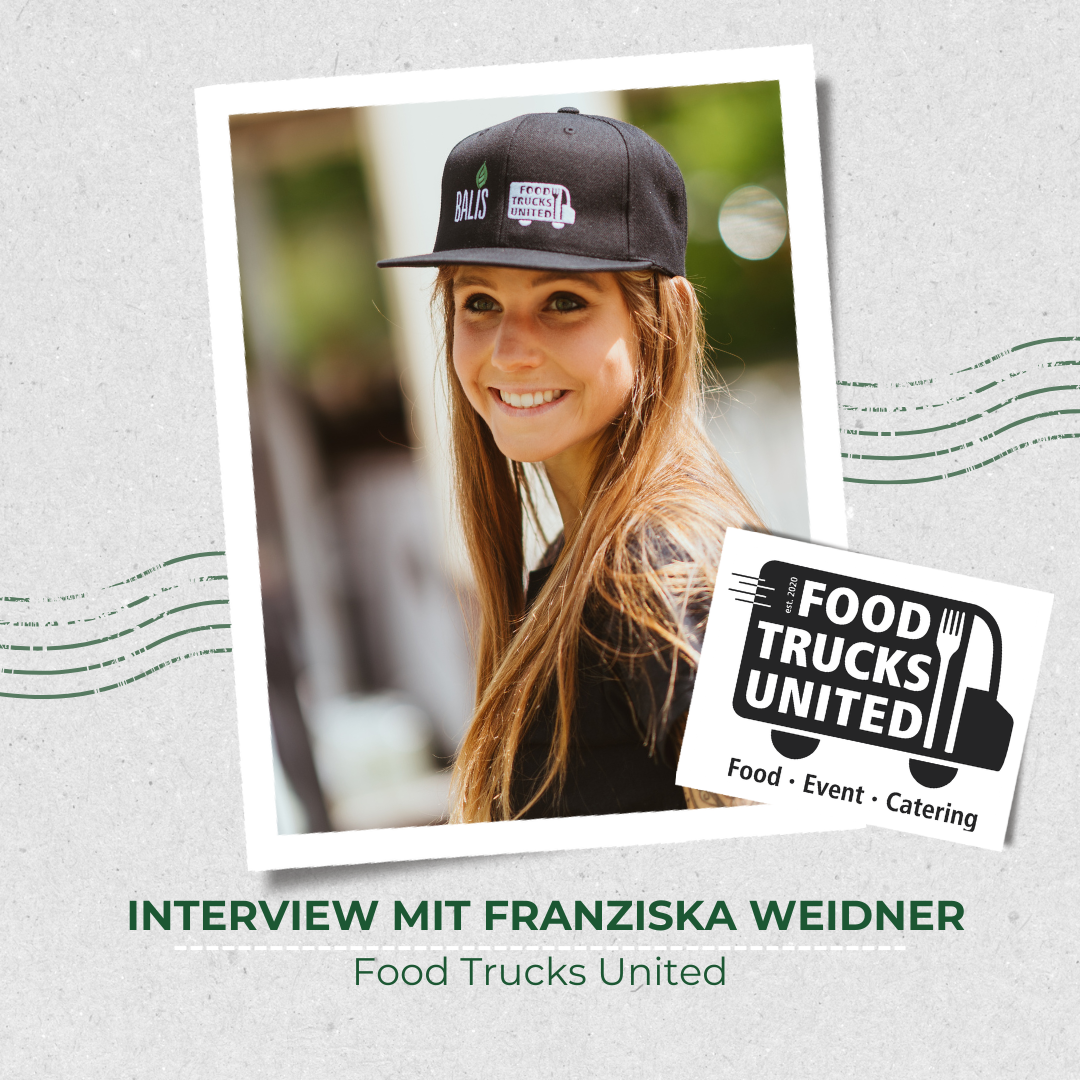
Franziska Weidner is a trained event manager. She completed her training at the Hofbräukeller in Munich, where she then worked for several years as a restaurant and event manager. She then moved to Do&Co and worked in the Allianz Arena and the Olympiapark, among other places. Franziska Weidner founded her food truck catering platform „Food Trucks United“ during the first coronavirus lockdown. Today, she works with a Germany-wide network of over 160 food trucks. The business model deliberately focuses on plannable food truck catering for companies - from summer parties and employee events to mobile canteen solutions. More information at: https://www.foodtrucksunited.de