What makes a good tavern in your opinion?
Peter Reichert: Down-to-earth charm, regional character, and friendly service. And a certain beer culture. After all, there’s also a culture of glassware and table settings—and for me, that includes the way beer is poured and presented. It’s not just about the product itself, but also about the atmosphere and appreciation. That’s why, at Donisl, for example, we place great importance on draft beer from wooden barrels.
Franziska Kohlpaintner: A good tavern also needs a relaxed atmosphere. Guests should walk in and immediately feel welcome. Above all, though, a tavern needs a soul. That comes from the people—the owners and the staff—but also from the space itself. At Donisl, many personal items, collectible mugs, and musical instruments hang on the walls. This creates an atmosphere that feels authentic and brings the history of the place to life.
Over the past few years, you’ve modernized the Donisl with events like „Tanz in Tracht“ and the „Kulinarium.“ Was this direction planned from the start?
Franziska Kohlpaintner: No, not at all. It developed step by step. Peter took over the Donisl in 2021—right in the middle of the COVID-19 pandemic. Back then, the main priority was to keep the business running, find employees, and establish a stable foundation.
Peter Reichert: At this stage, you don't immediately start thinking about large-scale event concepts. The first priority is just to get through it.
Franziska Kohlpaintner: Everything else has actually developed very organically together with our guests. Over time, you get a sense of which formats take hold and in which direction a place can evolve.
With „Kulinarium,“ you’ve made a conscious effort to attract new target audiences to Donisl. What’s the idea behind the concept?
Franziska Kohlpaintner: We wanted to show that traditional tavern cuisine and fine dining don’t have to be mutually exclusive. That’s why we invite top chefs to the Donisl to develop menus together with us. But it’s always important to us that the tavern’s DNA remains intact. Our philosophy is: upscale, but not pretentious. We don’t want „tweezers cuisine.“ It should always remain approachable and pay homage to traditional Bavarian pub cuisine. At the same time, this has also allowed us to attract guests who may not have been to the Donisl in many years. After an evening with us, some tell us, “I would never have walked in here otherwise.” And suddenly, they’re rediscovering the traditional tavern.
Peter Reichert: Basically, every culinary experience is a source of inspiration for us. Even if we see a French fry stand somewhere, we take a closer look: Why are people lining up? What kind of potatoes do they use? How does the concept work?
How do you define your target audience?
Franziska Kohlpaintner: That’s actually not an easy question to answer, because we cover a wide range of areas—from traditional à la carte dining to events, banquets, and our own event formats. Basically, though, Donisl caters to guests who are interested in Bavarian pub culture and want to experience it in a modern way.
Have expectations changed in recent years?
Peter Reichert: Absolutely. People are more intentional about going out these days. It’s no longer just about eating or drinking; it’s much more about the overall experience. Many people want to consciously take the time to enjoy an experience and have a place where they feel comfortable. In the past, it was often enough to simply be a good restaurant and open the doors. Today, you have to offer guests much more and constantly come up with new ideas.
Franziska Kohlpaintner: We’re realizing just how important real interactions have become. After all, restaurants are always social spaces. People of different generations come together, share stories, and want to leave their everyday lives behind for a few hours.
People are being more careful with their money these days. How can we still get guests excited about dining out?
Peter Reichert: People today think more carefully about what they spend their money on. By comparison, Bavarian restaurants aren’t really that expensive. Here, you can get a good meal made with regional products and excellent service for relatively little money. That’s a fair value for the price. And one of the advantages of a traditional tavern is that you don’t necessarily have to order a full meal. You can just as easily stop by for a beer or a light snack.
How have guests' dining and nightlife habits changed in recent years—especially during economically challenging times?
Franziska Kohlpaintner: Dining out continues to be very important to its patrons. Today, it’s much more about the overall experience. Many guests may be going out a little less often, but when they do, they want to consciously treat themselves to something special. Dining out isn’t just about food and drink—it’s also about socializing, that cozy pub atmosphere, and spending time together.
Donisl is located right in the heart of downtown Munich—but it’s somewhat tucked away in a passageway. Does this location present any particular challenges?
Peter Reichert: Locations in shopping arcades are generally considered rather challenging—whether in retail or the restaurant industry. From the outside, many people don't even realize what lies behind the Donisl.
Franziska Kohlpaintner: That’s exactly what we hear a lot. Many guests say afterward that they’re surprised by how spacious and atmospheric the interior of the restaurant feels. Still, our location right on Marienplatz is a huge privilege. In many ways, we certainly have it easier than an inn in the countryside.
How does delivery work in the heart of downtown?
Franziska Kohlpaintner: We can only receive deliveries between 6 a.m. and 10 a.m. That’s why our day starts very early. Practically everything comes in during that time—meat, fish, vegetables, and beverages. We work with many regional suppliers. Meat from the Werdenfels and Murnau regions, or fish from Lake Walchensee. For us, quality starts with our purchasing.
Regionality generally plays a major role for you. How important is this aspect to guests today?
Peter Reichert: When it comes to Bavarian cuisine in particular, sourcing ingredients plays an enormous role. Even the best chef can’t do much if the meat isn’t of the right quality. That’s why we’re very careful about which producers we work with.
The restaurant industry has been struggling with a shortage of skilled workers for years. How does this affect your day-to-day work?
Peter Reichert: Finding good employees has become significantly more difficult. But this applies to all industries—not just the restaurant industry.
Franziska Kohlpaintner: It’s more important than ever today to create a good work environment. When processes run smoothly and employees have the support they need, people actually enjoy working in the restaurant industry. A chef gets in a bad mood when equipment isn’t working or key ingredients are missing. A server gets in a bad mood when the cash register malfunctions or the beer is warm. Ultimately, it’s about ensuring that employees can focus on their actual job—being hosts.
Alongside Donisl, you also run the Bräurosl at the Munich Oktoberfest. How different are these two worlds?
Franziska Kohlpaintner: A day at the Wiesn is basically like a week—sometimes even a whole month—of regular operations. The pace is completely different, and a lot happens much faster. At Oktoberfest, you have to react within a very short time. If something breaks down there, you can’t just say, „The technician will come next week.“ You have to find a solution right away.
Peter Reichert: About 50 people work at Donisl, and around 500 at the Wiesn. There are about 240 employees working in service alone.
How long do the preparations for Oktoberfest take?
Franziska Kohlpaintner: Actually, planning begins even while the Wiesn is still underway. Many things are analyzed right away or discussed for the following year. And then the saying goes: After the Wiesn is before the Wiesn. First comes the complete takedown and the follow-up work. Things only really quiet down briefly in December—and after that, the planning starts all over again.
The Oktoberfest has also undergone culinary changes. What role do vegetarian dishes play today?
Franziska Kohlpaintner: It’s much more diverse than it was a few years ago. Originally, the Oktoberfest served only fried chicken, but that has changed over the years. Even though the “Wiesnhendl” is still the most popular Oktoberfest dish, guests now expect much more variety, including vegetarian and vegan options. There are incredible changes in this area every year. So we’re always trying out new things and seeing what goes over well with our guests.
Peter Reichert: Guests no longer just want to eat a salad with goat cheese; they also want something vegetarian and truly substantial on their plate to give them a good foundation for their visit to the festival tent.
With both Donisl and Bräurosl, you share very personal behind-the-scenes glimpses on Instagram.
How essential is it today for a restaurant business to also build a personal brand?
Franziska Kohlpaintner: A very big role. But we’ve learned that authenticity is more important than perfection. Spontaneous, genuine glimpses usually work better than completely staged content. We’ve worked with agencies from time to time, but we’ve often ended up moving away from that approach. Professional shoots often don’t work nearly as well as an honest look behind the scenes.
If you could look into a crystal ball: Where will Donisl and Bräurosl be in 20 years?
Franziska Kohlpaintner: Fortunately, we can’t see into the future. That’s exactly what makes the restaurant industry so exciting. You never know exactly how needs will change. The industry is constantly evolving.
Peter Reichert: I do believe, however, that events and banquets will become even more important in the future. They’re much easier to plan than traditional à la carte dining. At the same time, you have to earn that trust over the years. When someone is planning a corporate event or a big birthday party, they want to be sure that everything will go smoothly.
Franziska Kohlpaintner: Personal contact will always be crucial. Today, people are looking for places that feel authentic and where they can truly feel at home. And in the end, the fundamentals always remain the same: food, drink, and people. When these three elements come together, a tavern thrives.
Personal details:
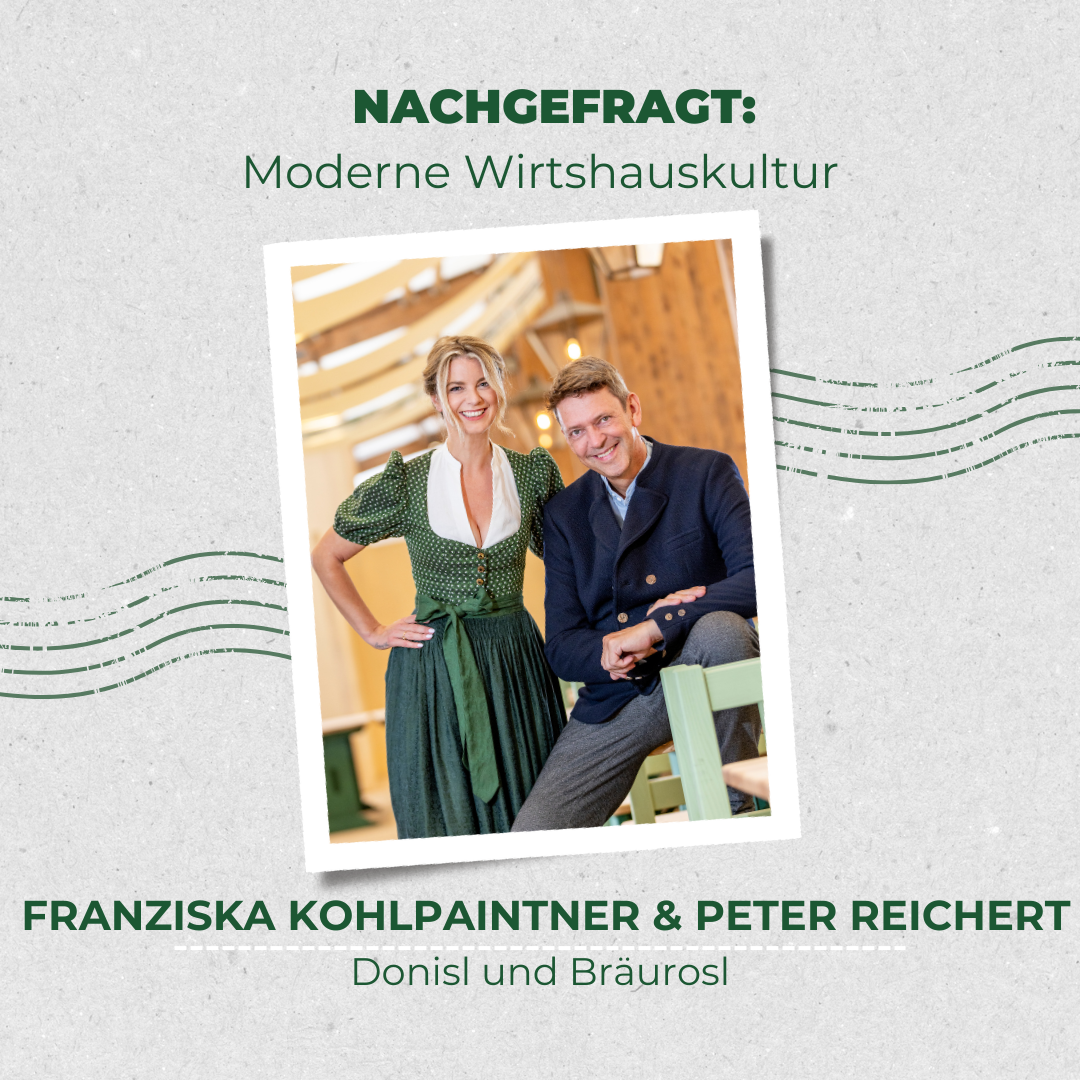
Peter Reichert and Franziska Kohlpaintner jointly run the long-established Munich restaurant Donisl at Marienplatz and the Oktoberfest tent Bräurosl. Even before taking over the Donisl in 2021, Reichert had already made a name for himself as a restaurateur—among other things, as the operator of the Seehof Hotel and Inn in Herrsching am Ammersee and as the host of the „Zur Schönheitskönigin“ tent at the Oidn Wiesn. He is also a passionate musician and is regarded as an experienced host with close ties to Bavarian pub and Oktoberfest culture. After many years of self-employment in the traditional costume industry, Franziska Kohlpaintner joined her partner’s businesses four years ago—without formal training in the restaurant industry, but with a strong commitment to service and a clear focus on the guest’s perspective.
you can reach us Monday - Friday from 7:30 - 17:00.